Southern Africa rewards a road trip better than almost anywhere else on the continent: good tar roads linking genuinely wild places, low traffic outside the cities, and enough infrastructure that a rental sedan or bakkie can get you to landscapes that would otherwise need a guide. These three routes — Namibia’s desert circuit, Lesotho’s mountain kingdom drive, and South Africa’s Garden Route — are the region’s classics for good reason. Each has its own road conditions, vehicle requirements and border logistics, laid out below.
At a Glance: Three Classic Routes
- Namibia’s desert circuit: Windhoek → Sossusvlei → Swakopmund → Skeleton Coast → Etosha. Mostly graded gravel; a standard 2WD rental handles the main routes in the dry season (May–October).
- Lesotho’s Mountain Kingdom Route: Sani Pass → Katse Dam → Maletsunyane Falls. Strictly 4×4 only, with cross-border paperwork required.
- South Africa’s Garden Route: Mossel Bay to Storms River (or extended from Cape Town). No 4×4 or border paperwork needed — the easiest of the three for a first Southern Africa self-drive.
Namibia: Sossusvlei – Etosha – Skeleton Coast
This is Southern Africa’s signature self-drive: red dunes, a wildlife-rich national park, and one of the most remote coastlines on earth, strung together on a loop of roughly two weeks out of Windhoek.
The Route and Road Conditions
From Windhoek, the road runs south to Sossusvlei for the dunes at Sesriem and Deadvlei, then north via Swakopmund and Spitzkoppe up the coast to the Skeleton Coast, before cutting inland to Etosha National Park and back to Windhoek. Most of this is graded gravel rather than tar, and it varies by section: inside Etosha, the main tourist circuit is well-maintained gravel that a standard 2WD rental handles comfortably in the dry season (May–October), though the rougher western Dolomite section suits a 4×4 better. The Skeleton Coast’s C34 — a roughly 480km salt-and-gravel road running from Swakopmund north to Terrace Bay — is smoother than ordinary gravel and doesn’t strictly require 4×4 in dry conditions, but becomes dangerously slippery after mist or rain, and fuel stops are rare enough that carrying a spare jerry can is standard practice.
Where to Stay
Sossusvlei itself has two well-matched options at different budgets: andBeyond Sossusvlei Desert Lodge for a private-concession splurge, or Sossusvlei Lodge right at the Sesriem gate for an earlier start on the dunes. On the Etosha side, Etosha Safari Lodge overlooks its own waterhole just outside the park.
Extending South: Fish River Canyon
Travellers with an extra few days sometimes tack on Fish River Canyon in the far south — Africa’s largest canyon and a full day’s drive from Sossusvlei, best combined into a longer three-week loop rather than squeezed into the standard circuit.
Lesotho: The Mountain Kingdom Route
Lesotho’s highlands drive is shorter in distance but tougher in terrain — a route built around one of Southern Africa’s most demanding mountain passes and two of its most dramatic engineered and natural landmarks.
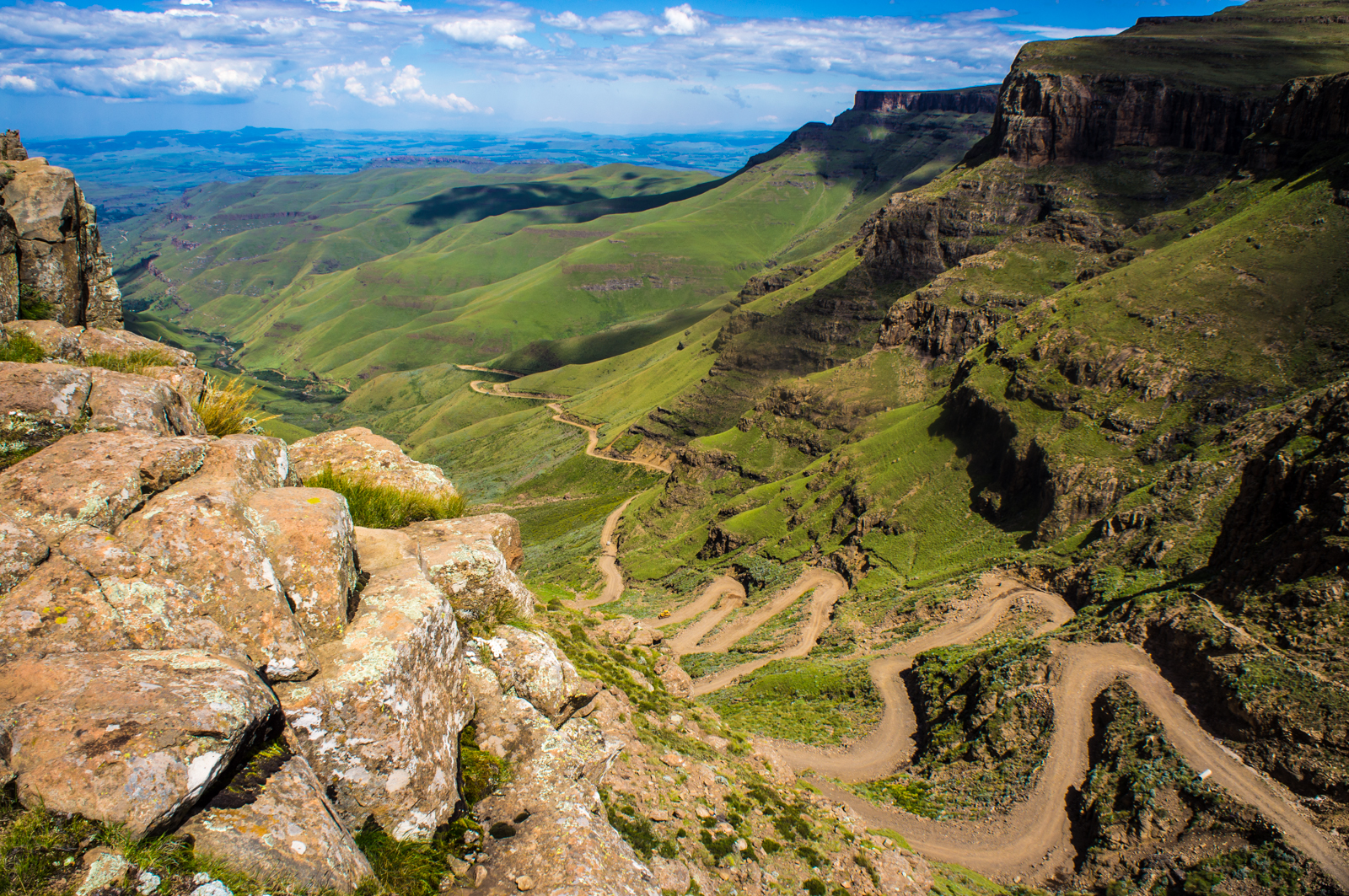
Sani Pass: 4×4 Only, No Exceptions
The route typically starts by climbing Sani Pass from KwaZulu-Natal into Lesotho — a switchback dirt track gaining nearly 1,000m in a few kilometres to the 2,876m Sani Top. Both the South African and Lesotho border posts enforce a strict 4×4-only rule; a 2WD vehicle will simply be turned back, and rental agencies charge roughly R650 (about $35) for the cross-border authority letter needed to take a rental vehicle over the border at all. Budget the fee and the vehicle type into your planning well before pick-up day.
Katse Dam
From the highlands, the route runs to Katse Dam, part of the Lesotho Highlands Water Project and, at 1,993m above sea level, Africa’s highest-elevation dam. Completed in 1997, the 185m-high concrete arch dam supplies water to South Africa’s Gauteng province and generates hydroelectric power for Lesotho — a striking piece of engineering against the surrounding Maloti peaks, and a worthwhile stop even for travellers with no particular interest in infrastructure.
Maletsunyane Falls
The route’s natural centrepiece is Maletsunyane Falls near Semonkong, a 192m single-drop waterfall best known for hosting the world’s longest commercially operated single-drop abseil at 204m, certified by Guinness World Records. Base yourself at Semonkong Lodge, right beside the falls, or Maliba Mountain Lodge in Ts’ehlanyane National Park for a more comfortable finish to the route.
South Africa: The Garden Route
The Garden Route is Southern Africa’s most accessible self-drive — entirely tarred, well signposted, and doable in a standard sedan with no special permits.
The Route
Most itineraries run along the N2 highway from Mossel Bay to Storms River, a core stretch of roughly 200–300km depending on detours, though many travellers extend it from Cape Town, making the full drive closer to 800–950km one-way. Along the way, George marks the start of the classic section, the road winds between lakes and lagoons through Wilderness, and Knysna — sitting on its tidal lagoon, nearly enclosed by the sandstone cliffs known as the Heads — is the most-visited stop on the route.
Practicalities
Unlike the Namibia and Lesotho routes, the Garden Route needs no 4×4 and no special border paperwork, making it the easiest of the three for a first Southern Africa self-drive trip or a family itinerary. Fuel stations and towns are frequent enough that range anxiety isn’t a concern, and the route works comfortably in any season, though the shoulder months (March–May, September–November) avoid both midsummer crowds and midwinter Cape storms.
For the More Adventurous: Beyond the Three Classics
Travellers who want to push further off the tar should look at Botswana’s Central Kalahari Game Reserve — genuinely remote, sandy 4×4-only terrain that demands high clearance, recovery gear and enough fuel, food and water for the full trip, with mobile coverage essentially nonexistent inside the reserve. It’s a serious step up in difficulty from any of the three routes above, best attempted only with prior 4×4 experience or as part of a small convoy.
Choosing Your Route
If it’s your first Southern African self-drive, start with the Garden Route: tar roads, short driving days, and no special vehicle needed. If you want the classic wildlife-and-desert experience with moderate off-road demands, Namibia’s Sossusvlei–Etosha–Skeleton Coast circuit delivers it on a 2WD-friendly dry-season route. And if you want mountains, engineering and one of the world’s great single-drop waterfalls in a country most travellers never reach, Lesotho’s highlands route is worth the 4×4 rental and the Sani Pass paperwork.
Frequently asked questions
Do I need a 4×4 for these road trips?
It depends on the route. Sani Pass into Lesotho is strictly 4×4 only — both border posts turn back 2WD vehicles — and Etosha’s rougher western Dolomite section suits a 4×4 better too. The main Etosha circuit and the entire Garden Route, by contrast, are comfortable in a standard 2WD rental.
What does the Sani Pass cross-border rental paperwork cost?
Rental agencies typically charge around R650 (about $35) for the cross-border authority letter needed to take a rental vehicle from South Africa into Lesotho via Sani Pass. Budget the fee, and the 4×4 vehicle requirement, into your planning before pick-up day.
Which route is easiest for a first Southern Africa self-drive trip?
The Garden Route. It needs no 4×4 and no special border paperwork, fuel stations and towns are frequent, and it works in any season — making it the most beginner-friendly of the three classics, including for families.
When is the best time to drive Namibia’s desert circuit?
The dry season, May to October, is best. Inside Etosha, the main tourist circuit is well-maintained gravel that a standard 2WD rental handles comfortably in this window, though the rougher western Dolomite section still suits a 4×4.
How long is the Garden Route?
The core stretch from Mossel Bay to Storms River runs roughly 200–300km depending on detours. Many travellers extend it from Cape Town, which makes the full one-way drive closer to 800–950km.
What is the Skeleton Coast’s C34 road like?
The C34 is a roughly 480km salt-and-gravel road running from Swakopmund north to Terrace Bay along Namibia’s Skeleton Coast. It’s smoother than its remote reputation suggests, though it still demands the usual gravel-road caution.
What is Katse Dam?
Katse Dam is part of the Lesotho Highlands Water Project, set high in the Maloti mountains and reached as part of the Mountain Kingdom road trip route between Sani Pass and Maletsunyane Falls.
When’s the best time to drive the Garden Route?
It works comfortably in any season, but the shoulder months — March to May and September to November — avoid both the midsummer crowds and the midwinter Cape storms.
About the author
Makume Toti is a digital marketing veteran with 15+ years of cross-vertical experience and a 12-year foundational career in the airline industry. He leverages his extensive insider knowledge of travel and enterprise SEM & AIO expertise to curate authoritative guides to Southern Africa for ExploreMzansi.